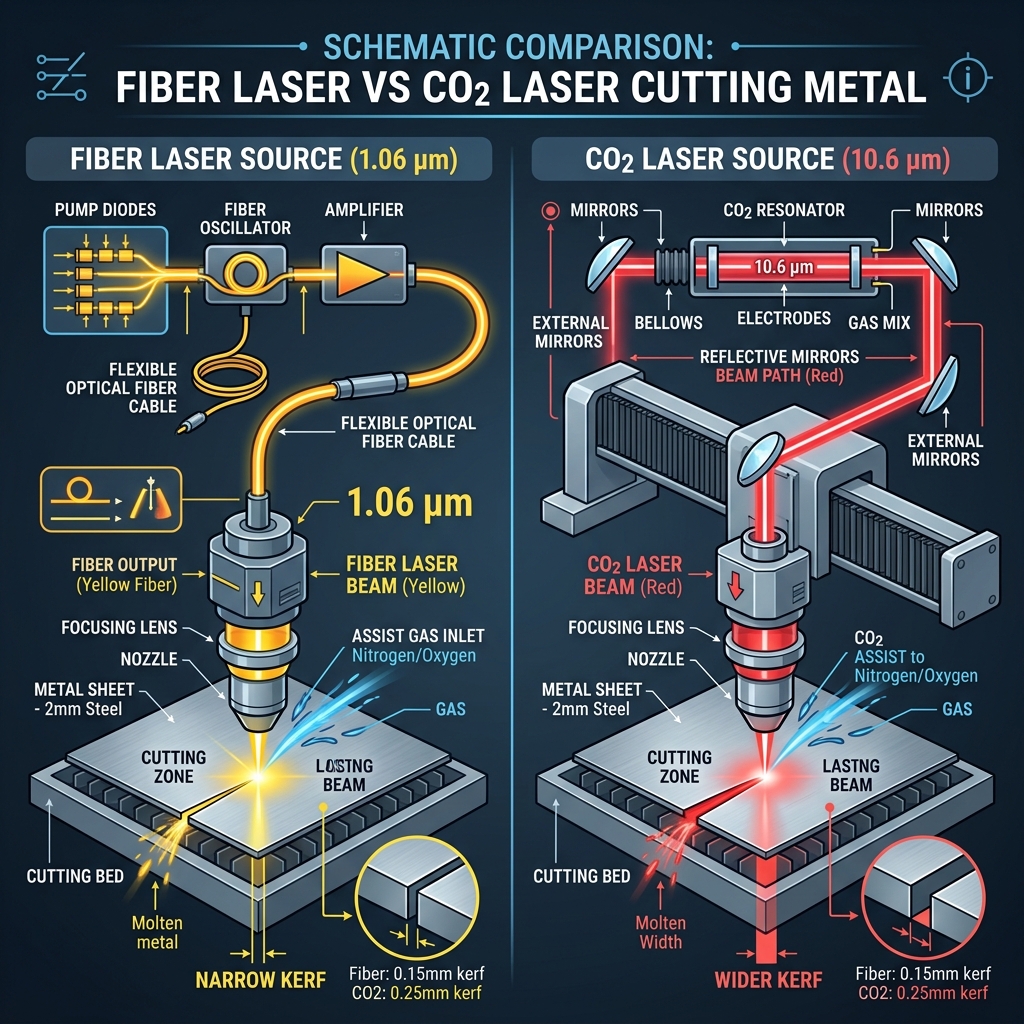
When companies plan to invest in laser cutting, one common question is whether to choose fiber laser or CO2 laser.
Both technologies have their place. For modern sheet metal fabrication and industrial metal cutting, fiber laser machines are highly preferred because of speed, efficiency, and lower maintenance needs.
What Is a Fiber Laser?
A fiber laser uses a fiber laser source to generate a high-intensity beam. It is widely used for cutting mild steel, stainless steel, aluminium, brass, and copper.
Fiber laser machines are popular in sheet metal fabrication, automotive components, electrical panels, enclosures, machinery manufacturing, precision components, and job shops.
What Is a CO2 Laser?
A CO2 laser uses gas-based laser technology. It has been used for many years and is suitable for certain non-metal and older cutting applications such as acrylic, wood, leather, plastics, non-metal cutting, engraving, and specific metal setups.
Key Difference 1: Material Suitability
Fiber laser is highly suitable for industrial sheet metal. CO2 laser is commonly associated with non-metal applications, though it has also been used historically for metal cutting.
Key Difference 2: Cutting Speed
Fiber laser machines generally provide faster cutting speeds for thin and medium metal sheets, improving output, delivery speed, utilization, and cost per part.
Key Difference 3: Energy Efficiency
Fiber laser machines are generally more energy efficient compared to older laser technologies, helping reduce operating cost over time.
Key Difference 4: Maintenance
CO2 lasers have more optical components and gas-related maintenance requirements. Fiber lasers usually have lower maintenance needs and simpler beam delivery.
Key Difference 5: Operating Cost
Compare electricity, consumables, gas usage, maintenance, downtime, spare parts, operator skill, and cutting speed. For many metal applications, fiber laser offers better productivity and operating efficiency.
Which One Should You Choose?
Choose fiber laser for sheet metal, stainless steel, mild steel, aluminium, brass, copper, industrial fabrication, high-speed metal cutting, better productivity, and lower maintenance. CO2 may be considered for non-metal cutting or specific suitable applications.
Conclusion
For modern metal fabrication, fiber laser machines are usually the better choice, but the final decision should depend on material, thickness, application, production volume, and budget.
Call to Action
Confused between fiber laser and CO2 laser? Speak to Adhikhah and our team will guide you with the right laser solution.